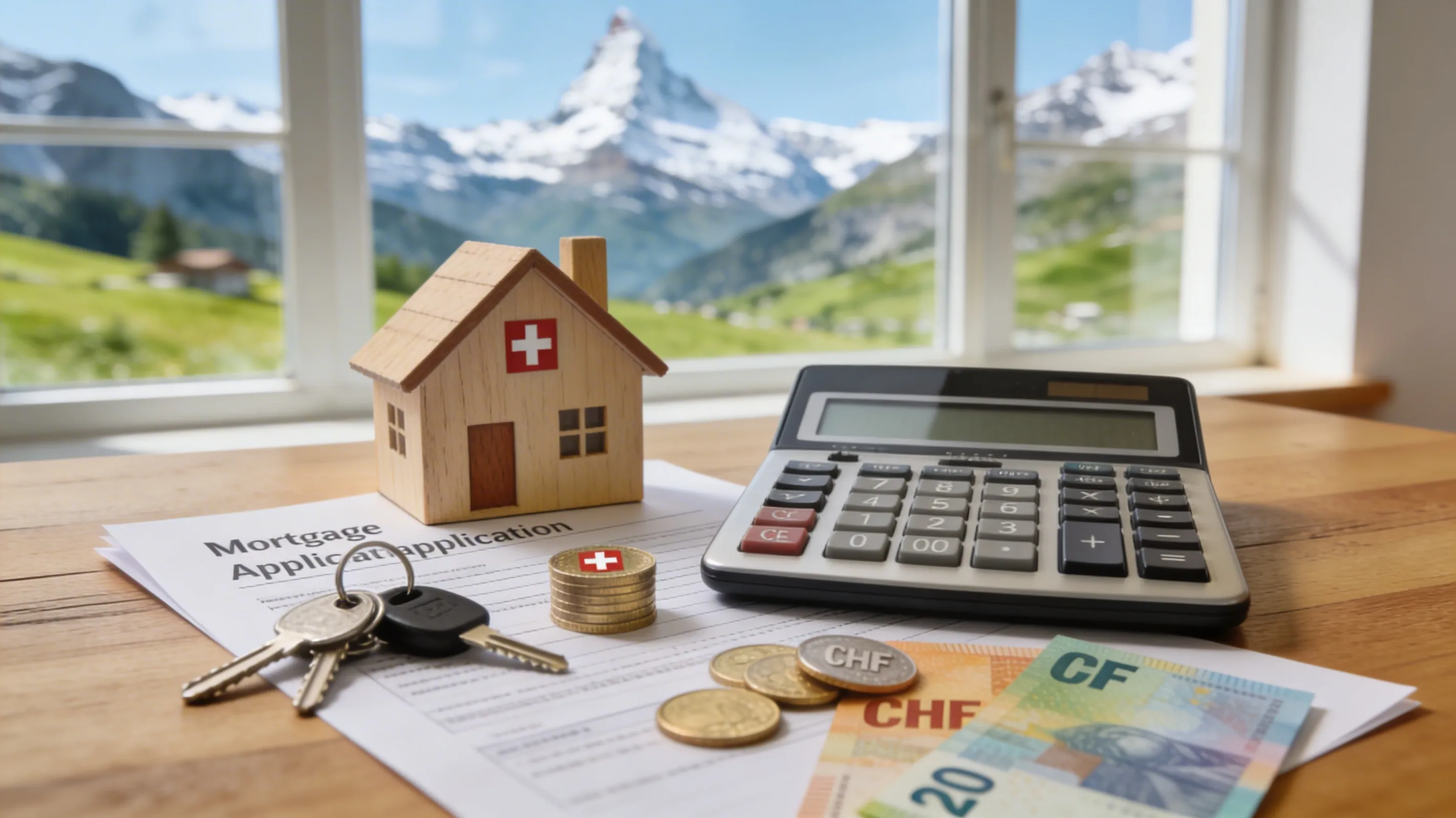
Swiss mortgages work fundamentally differently than those in almost any other country. The most surprising fact for newcomers is that most people keep their mortgage forever. In Switzerland, maintaining a high level of debt often makes more financial sense than paying it off completely, thanks to the unique relationship between mortgage debt, wealth taxes, and income deductions.
Before you approach a bank or sign any paperwork, you need to understand exactly how this system works. Otherwise, it is incredibly easy to lock yourself into a suboptimal deal for a decade.
1. How Much Can You Borrow?
Banks in Switzerland use exceptionally strict and conservative rules to determine your borrowing capacity. They want to guarantee that you can afford your home even in the worst case economic scenarios.
The Affordability Calculation
When a bank runs your numbers, they do not use the actual, current market interest rates. Instead, they stress test your finances using a theoretical interest rate of 5%. This is typically significantly higher than the actual rate you will pay. On top of this 5% rate, the bank adds a mandatory 1% annual amortization cost and another 1% for maintenance costs.
To be approved for the mortgage, this total calculated cost must be strictly less than one third of your gross income.
What Counts as Income?
Banks will primarily look at your previous year’s taxable income. If you receive regular bonuses, the bank will usually require several years of documented history before counting them toward your affordability. If you are buying with a partner, both incomes are combined. In some cases, banks will also partially count projected rental income if the property includes a rentable unit.
The frustrating reality for many buyers is that they could easily afford the actual monthly payments at current market rates, but the bank’s theoretical 5% stress test disqualifies them from getting the loan.
2. Down Payment and Funding Requirements
To buy a property in Switzerland, you must provide a minimum down payment of at least 20% of the property value. The bank will then finance the remaining 80%.
This 20% cannot just come from anywhere. The law dictates how you must fund this down payment.
| Funding Source | Legal Requirement |
|---|---|
| Hard Cash (Savings, gifts, investments, inheritance) | Must cover at least 10% of the property value. |
| Pension Funds (Pillar 2 or Pillar 3a) | Can cover up to a maximum of 10% of the property value. |
Beyond the pure down payment, you must budget additional hard cash for the transaction costs. You will need to pay for notary fees, land registry fees, and property transfer taxes. These taxes vary wildly depending on your canton and can add significant, non mortgageable costs to your purchase. A safe rule of thumb is to budget approximately one quarter of the property’s purchase price in total available capital before starting your search.
3. Using Your Retirement Funds
If you do not have the full 20% in cash, you can leverage your Swiss pension savings (Pillar 2 or Pillar 3a) to cover up to half of the down payment. Switzerland’s three pillar pension system allows employees to accumulate significant retirement capital that can be accessed early for home purchases. For a complete explanation of how the pillars work and the tax implications of accessing these funds, see our pensions guide. You have two distinct ways to use your pension for property.
Withdrawing the Funds
You can permanently remove the money from your pension fund and pay it directly toward the property. This immediately reduces your mortgage debt and lowers your monthly interest payments. However, this permanently lowers your future retirement income. Furthermore, you will owe an immediate withdrawal tax, and you will be legally blocked from making tax deductible voluntary pension contributions until you pay the withdrawn amount back into the fund.
Pledging the Funds
Instead of withdrawing the money, you leave it inside your pension fund but pledge it to the bank as collateral. Because you are borrowing the full amount, your overall debt is higher, which means your monthly interest payments are higher.
However, pledging has major advantages. You keep your retirement savings intact, allowing them to continue growing. You retain the ability to make tax deductible voluntary contributions to your pension. Plus, your higher mortgage debt allows you to claim higher tax deductions on the interest you pay.
Generally, if you are close to retirement age, pledging is often the safer, more tax efficient route. If you are young and your occupational pension fund generates very poor returns, withdrawing the money and investing your monthly cash flow savings elsewhere might be mathematically superior.
4. The Amortization Rules
Switzerland divides your mortgage into two separate tranches, and the rules for paying them back are entirely different.
- First Mortgage (up to 65% of property value): You are never legally required to pay this down. You can simply pay the interest on this debt forever.
- Second Mortgage (from 65% to 80% of property value): You must completely amortize (pay off) this portion of the debt within 15 years, or before you reach retirement age, whichever comes first.
This means you are only required to pay down 15% of the original loan amount. Once your total debt hits 65% of the property value, you can stop amortizing entirely.
When paying down that mandatory second mortgage, you again have two choices.
Direct Amortization
You pay cash directly to the bank every month or year. Your total debt decreases, which means your interest payments slowly decrease over time. This is simple and straightforward, but your tax deductions will also shrink every year as your debt goes down.
Indirect Amortization
Instead of paying the bank, you pay your amortization amount into a specialized Pillar 3a account that is pledged to the bank. Your actual mortgage debt stays exactly the same, meaning you keep deducting the maximum amount of interest on your taxes every year.
Meanwhile, the money in your pledged Pillar 3a account grows tax free. When it is time to retire, the bank simply takes the money from the Pillar 3a account to clear the second mortgage in one lump sum. This strategy provides massive tax advantages, but you must be careful. Banks often force you to use their own Pillar 3a cash accounts for this setup, which frequently offer terrible interest rates. Always negotiate to use a high yielding, invested Pillar 3a account if you choose indirect amortization.
5. Choosing Your Mortgage Type
When you sign your contract, you must choose how your interest rate is calculated.
Fixed-Rate Mortgage
You lock in a specific interest rate for a set number of years, typically ranging from 2 to 15 years. This is overwhelmingly the most popular choice in Switzerland. It provides absolute budget stability, predictable monthly payments, and complete peace of mind.
SARON Mortgage
This is a variable rate mortgage tied to the Swiss Average Rate Overnight (SARON). Your interest rate equals the official SARON rate plus a fixed margin charged by the bank. The rate adjusts periodically, usually every three months. This is best for buyers who can handle financial fluctuations, who believe national interest rates will drop, or who plan to sell the property within a few years. If national rates spike, your monthly payments will immediately increase.
Mixing and Matching
You are allowed to split your overall loan into multiple tranches with different terms. For example, you could put half your debt into a 10 year fixed mortgage and half into a SARON mortgage.
However, you must be extremely careful to align the renewal dates. If you have tranches that expire years apart, you will be trapped. No competing bank will take over just half of a mortgage, meaning your current bank will have a monopoly on you and can offer you terrible renewal rates knowing you cannot leave.
6. Why the Swiss Never Pay Off Their Mortgages
It deeply confuses foreigners, but most Swiss homeowners purposefully maintain their mortgage at roughly 65% of their property’s value until the day they die. The reason is purely mathematical.
Mortgage interest payments are fully tax deductible from your income. At the same time, maintaining a high level of debt actively reduces your taxable net worth, saving you money on your annual wealth taxes. Because historical mortgage interest rates in Switzerland are quite low, you will almost always earn more money by taking your spare cash and investing it in the stock market rather than using it to pay off a 1.5% mortgage.
If you pay off your mortgage, you lose your biggest income tax deduction, your wealth taxes increase, and you tie up all your liquid capital in bricks and mortar. The only time it makes sense to aggressively pay down your debt is if you are approaching retirement and the bank is threatening to reassess your affordability based on your lower pension income, or if being debt free provides you with invaluable psychological peace of mind.
7. How to Find the Best Rate
You can secure a mortgage from traditional banks, cantonal banks, insurance companies, and even some occupational pension funds. insurance companies often offer highly competitive rates for long term fixed mortgages, but they usually have stricter lending requirements and often refuse to accept pension fund pledges, demanding the full 20% down payment in hard cash.
To ensure you get the best deal, never accept the first offer from your primary bank.
Use online comparison platforms or work directly with an independent mortgage broker. Brokers negotiate on your behalf, compare dozens of providers, and handle the complex paperwork. Because they earn a commission directly from the lending bank, their services are usually free or very low cost to you. Once you have multiple quotes, use them as leverage to force the banks to compete for your business.
8. Conclusion
Swiss mortgages are unique because holding debt long term is purposefully designed to be a financially optimal choice. Understanding the strict lending rules, structuring your amortization for maximum tax efficiency, and shopping around for the lowest rate are key steps to a successful property purchase.
When you are weighing your options, setting up an indirect amortization plan through a Pillar 3a account usually offers the best tax advantages. It is also key to gather multiple quotes from independent brokers to give you leverage when negotiating better terms.
Remember that you need at least a 20% down payment, with a hard minimum of 10% in pure cash. Your carrying costs will be stress-tested at a theoretical 5% rate, and you are legally required to amortize the debt down to 65% of the property’s value.
If you are currently navigating this process, you can read Buying Property in Switzerland: What to Know Before You Buy to understand the broader real estate market.
If you prefer to skip the hassle of comparing offers, our team works independently of any bank or insurance company and can find the most suitable mortgage options for your situation completely free of charge. You can contact us directly, and we will handle the research for you.